
Building Safer Autonomous Systems
I study how formal requirements can guide the design of autonomous systems and help establish what guarantees an existing system can support.
Across perception, planning, and control, I develop methods for constructing systems that satisfy a specification and for verifying their behavior under explicit assumptions. Where uncertainty limits those guarantees, I use statistical methods to quantify risk. When testing is the available evidence, I use the requirements to choose experiments that expose weaknesses and inform the next design revision.
Research Areas
Explore research map →Requirements-driven testing
In S-TaLiRo, we used the distance from a requirement violation to guide the search for failures in simulated automotive systems.
Verification of learning-enabled systems
We identified aircraft encounters that triggered unsafe neural network advisories, used them to guide repairs, and verified the revised networks.
Statistical guarantees and runtime monitoring
We derived statistical bounds on the safety margin of a predicted trajectory that remain valid under a bounded shift in operating conditions.
Safe planning and control
We built a diffusion planner that steers a simulated tractor-trailer around obstacles while keeping the trailer from jackknifing.
Publications
Temporal Specification Guidance for Text-to-Video Generation
LogSTOP: Temporal Scores over Prediction Sequences for Matching and Retrieval
Safety-aware Model Predictive Path Integral Control with Signal Temporal Logic
Diffusion-Guided Search via Exponential Tilting (DiffTilt): An Application to Falsification of Safety-Critical Systems
FalconTrack: Photorealistic Auto-Labeled Perception and Physics-Aware Vision-Based Aerial Tracking
Patents
System and method for manipulating an omnidirectional cart using an armed robot
Learning abstractions for multi-robot path planning in unstructured environments
Systems and methods for risk-bounded control barrier functions
Methods and systems for spatio-temporal regular expression matching
Systems and methods for online monitoring using a neural model by an automated vehicle
Show more (13 remaining)Show fewer patents
Barrier rate-guided model predictive path integral (MPPI) for collision aware and narrow environment navigation
Risk aware model predictive path integral control for stochastic hybrid systems
Neural configuration distance function for continuum robot control
Methods of qualitative and quantitative verification of complex learning-enabled systems and temporal logic verification
Producing a simulation recording to test an automated driving system
Methods and systems for spatio-temporal regular expression matching
System and method for optimization of vehicle perception sensor configuration
System and method for safe control synthesis for hybrid systems through local control barrier functions
Systems and methods for predictive risk-aware control of vehicles in dynamic environments
Systems and methods for control barrier functions for enhanced feasibility in optimization-based control
Timed partial order identification for task learning from data
Neural network verification for neural network controllers
Temporal logic robustness guided testing for cyber-physical systems
Teaching
Southern Illinois University
Mentorship
2026
Muhan Lin [Purdue University]
Tool substitution for vision-language-action policies
Kai-Chun Chang [UC Berkeley]
Requirements-driven falsification of automated vehicles using diffusion models
Evangelos Psomiadis [Georgia Tech]
Graph neural networks for multi-agent pickup and drop-off
2025
Eric Vin [UC Santa Cruz]
Diffusion-based trajectory generation
2024
2023
2022
Software
CBFKit: A Control Barrier Function Toolbox
Design and simulate robot controllers with control barrier functions in Python, then run them with ROS 2.
Example for CBFKit
How closely can a robot following a goal command pass a circular obstacle?
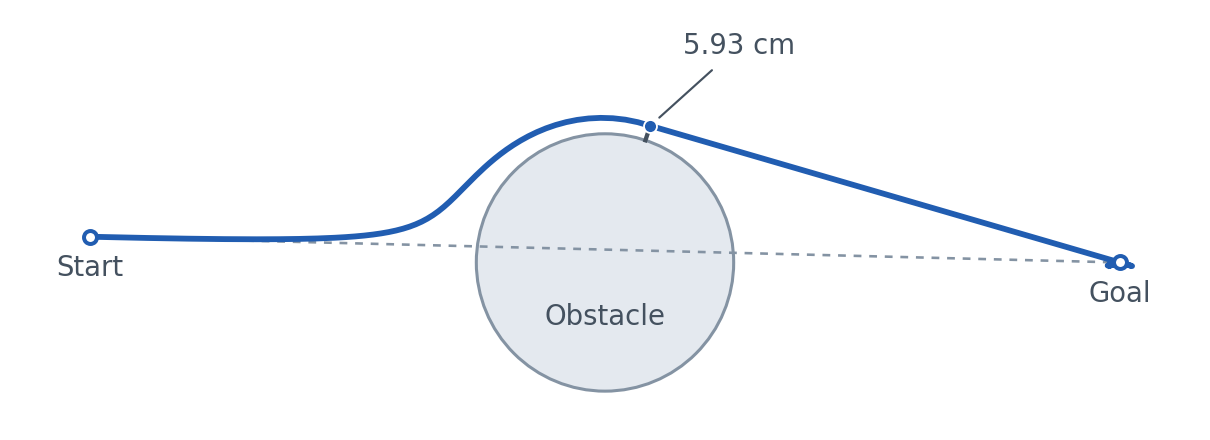
- Obstacle radius
- 0.50 m
- Closest to center
- 0.56 m
- Clearance
- 0.06 m
The goal command points through the obstacle. In the quickstart simulation, the barrier filter adjusts the velocity at each step. At the closest sampled position, the robot clears the perimeter by about six centimeters.
CBFKit quickstartSTREM: Spatio-Temporal Pattern Matching over Perception Streams
Search annotated video for sequences of spatial events using regular expressions.
Example for STREM
Where do pedestrian and car detection boxes overlap for two consecutive frames?
[NE([:pedestrian:] & [:car:])]{2}RTAMT: Runtime Robustness Monitors for STL
Monitor a signal as it arrives and measure how closely it satisfies a Signal Temporal Logic specification.
Example for RTAMT
Does a measured gap stay at least 2 m wide for three consecutive samples?
- Sample 1
- 2.4 m
- Sample 2
- 2.1 m
- Sample 3
- 1.8 m
For this sample trace, always[0,2] (gap >= 2) has robustness −0.2 m at the first sample. The monitor can report that verdict when the third reading arrives.
RTAMT discrete-time monitorTLTk: Parallel Robustness Computation for Temporal Logic
Compute temporal logic robustness in parallel across recorded signals to evaluate test runs.
Example for TLTk
Which point on a recorded trajectory comes closest to an exclusion zone?
- Point A
- 0.8 m outside
- Point B
- 0.2 m outside
- Point C
- 0.5 m outside
TLTk can compute the signed distances for all three samples in parallel. For the requirement to stay outside the zone, the smallest distance sets the robustness of this illustrative trace. Point B leaves only 0.2 m of clearance.
TLTk paper, Figure 2S-TaLiRo: Toolbox for Testing and Verification of CPS
Search MATLAB and Simulink models for trajectories that violate a temporal logic requirement. Its falsification benchmarks have been used in ARCH-COMP.
Example for S-TaLiRo
Can a throttle and brake sequence make a transmission shift out of first gear too soon?
- Required dwell
- 2.5 s
- Example downshift
- 8.0 s
- Next upshift
- 10.0 s
This illustrative trace spends only 2.0 s in first gear after the downshift. S-TaLiRo varies the throttle and brake signals in simulation and uses the robustness score to search for inputs that produce such a violation.
Automatic transmission benchmarkVERITEX: Deep Neural Network Verification
Compute the reachable outputs of a neural network and use the resulting sets to guide repairs.
Example for VERITEX
Which aircraft encounter conditions cause a neural network to violate an advisory requirement?
- Networks checked
- 45
- Violated a property
- 11
- Repaired
- 11
In the aircraft collision-avoidance study, VERITEX propagated sets of encounter conditions through each network. Inputs that reached a prohibited combination of advisory scores guided repair. The authors then checked the repaired networks against all three properties.
Aircraft controller repair study, §6.1NDF-CoRoCo: Continuum Robot Control
Use learned distance fields to check collisions and plan motions for continuum robots.
Example for NDF-CoRoCo
How does the number of bending links change the route a continuum robot can take?
- 4 links
- 158 steps
- 5 links
- 82 steps
- 7 links
- 43 steps
In the reported simulations, the planner used a learned distance field to check candidate arm shapes against obstacle points. The four-link arm took a detour. The seven-link arm bent along a more direct route and reached the goal in 43 steps.
Cluttered navigation study, Table IVHonors & Recognition
Awards and Distinctions
- 2026
Oral Presentation (Top 2%)
Conference on Uncertainty in Artificial Intelligence (UAI)
- 2024
Finalist for Best Paper Award
ACM/IEEE International Conference on Cyber-Physical Systems (ICCPS)
Robust Conformal Prediction for STL Runtime Verification under Distribution Shift
- 2023
Finalist for Best Paper Award
International Conference on Runtime Verification
- 2022
Best Software Artifact Award
International Conference on Formal Modeling and Analysis of Timed Systems
- 2017
Outstanding PhD Student
Computer Science, Arizona State University
- 2014
Finalist for Best Student Paper Award
The 4th Annual IEEE International Conference on Cyber Technology in Automation, Control and Intelligent
Robustness-guided temporal logic testing and verification for stochastic cyber-physical systems
Invited Talks
- 2024
- 2023
Advancing Safety in ML-Driven Systems: Spatio-Temporal Quantitative Verification Techniques
Stony Brook University
- 2023
Safety in Advanced ML-Driven Systems
University of Michigan · November 15
- 2022
Verification and Synthesis of Cyber-Physical Systems with Learning-enabled Components
NSF Center of Cognitive Autonomy · April 8Program
- 2021
Autonomous CPS: Verification and Control
SNR Workshop at QONFEST · August 23Program
- 2021
Simulation-Based Testing of Autonomous CPS
Stony Brook University · April 15
- 2021
Verification of Deep Neural Networks
University of Southern California, Center for Cyber-Physical Systems and the Internet of Things
Leadership & Service
Chair and Advisory Roles
Program Chair
Workshop on Monitoring and Testing of Cyber-Physical Systems (MT-CPS), 2018
Repeatability Evaluation Chair
ACM International Conference on Hybrid Systems: Computation and Control (HSCC), 2021, 2020
Advisory Committee Member
HSCC Repeatability Evaluation, 2020
Program Committees
- HSCC
- Hybrid Systems: Computation and Control: 2027 (with ICCPS), 2026 (with ICCPS), 2025, 2024, 2023, 2022
- EMSOFT
- International Conference on Embedded Software: 2026, 2018 (work in progress track)
- AAAI
- AAAI Conference on Artificial Intelligence: 2024, 2023
- IJCAI
- International Joint Conference on Artificial Intelligence: 2016
- VehicleSec
- USENIX Symposium on Vehicle Security and Privacy: 2027 (Cycle 1), 2026
- AutoSec
- Workshop on Automotive and Autonomous Vehicle Security: 2022
- SafeThings
- IEEE Workshop on the Internet of Safe Things: 2020
- DARS
- Workshop on Design and Analysis of Robust Systems: 2019
- HSCC RE
- HSCC Repeatability Evaluation Committee: 2019, 2018, 2017, 2016
Reviewing and Memberships
Journals and magazines: IEEE Transactions on Automatic Control, IEEE Systems Journal, IEEE Computational Intelligence Magazine (2021, 2022), Nonlinear Analysis: Hybrid Systems (2024), Acta Informatica, Logical Methods in Computer Science.
Conferences: IEEE Conference on Decision and Control (CDC), IEEE International Conference on Automation Science and Engineering (CASE 2023), IEEE International Conference on Robotics and Automation (ICRA 2027), American Control Conference (ACC), IEEE/RSJ International Conference on Intelligent Robots and Systems (IROS), International Conference on Cyber-Physical Systems (ICCPS), Applied Verification for Continuous and Hybrid Systems (ARCH).
Memberships: IEEE Senior Member, ACM Member.